Meeting inner experience through conscious breathing and regulation
🌬️ You’re welcome to read this page at your own pace. If anything here feels like too much, you can pause, take a breath, or come back later.
Breathing is one of the simplest ways to reconnect awareness with the body.
Insight may expand the mind.
But breathing helps to meet the experience more fully.
👉 Try a 3-minute breathing practice
🌬️ breathing · regulation · presence
When we consciously breathe, the nervous system begins to shift.
The mind slows down, and the body becomes more available.
This is often where integration begins.

Why breathing matters in inner development
Moments of expansion can be powerful.
An insight appears.
A belief dissolves.
A new perspective opens.
But expansion alone is not integration.
Without a pause, the mind may keep searching for the next insight.
Or the body becomes overwhelmed by what has opened.
Breathing slows that momentum.
It creates space where experience can settle.
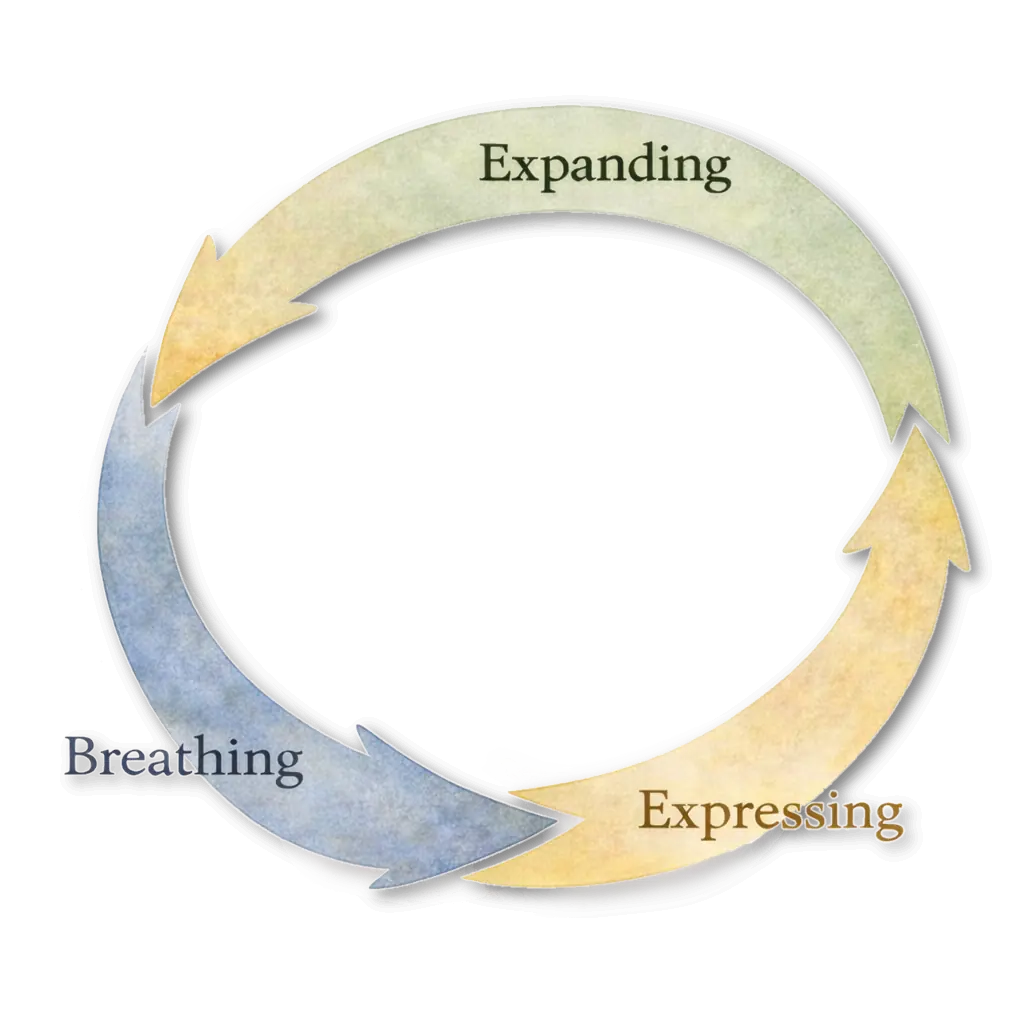
This is why breathing is the middle movement in the rhythm of creative spirituality:
Expanding → Breathing → Expressing.

Listening to the signals of the nervous system
Our nervous system continuously sends signals about what is happening inside and around us.
Some signals are strong and clear.
Others are quiet and difficult to name.
Through gentle attention and breathing, we can begin to recognize these signals.
Three patterns appear frequently in human experience.
1. The alarm signal
Sometimes the body reacts quickly.
The heart races.
Muscles tense.
Attention narrows.
This is the nervous system responding to perceived danger.
It prepares the body to act.
In these moments, breathing slowly and lengthening the exhale can help the body find safety.
2. The “something is off” signal (mismatch)
Other times the feeling is subtler.
There may be a quiet unease.
A sense that something does not quite make sense.
The mind begins to circle around a question.
This signal often appears when our inner map of a situation does not match what we are experiencing.
It is less like a fire alarm
and more like a dashboard light in a car.
The light does not mean immediate danger.
It simply invites attention.
Breathing creates the pause where we can explore the signal with curiosity rather than urgency.
3. The shutdown signal
Sometimes the opposite happens.
Energy drops.
Thoughts become foggy.
The body feels distant.
This is a protective response where the nervous system withdraws.
In these moments, gentle movement or reconnecting with surroundings can gradually restore presence.
Breathing and the return to safety
When breathing slows and deepens, the nervous system can shift toward a state of safety and connection.
In this state, something important becomes possible: curiosity.
Curiosity allows us to explore experience without immediately trying to control it.
Instead of reacting automatically, we can ask:
What is this signal showing me?
What might be happening here?
Breathing creates the conditions for this kind of exploration.
Sometimes, this sense of safety is supported by an inner tone of voice. You can explore this in The Inner Child Tone.
If you’d like to experience conscious breathing directly, you can try the practice below.
A simple conscious breathing practice
You can try this practice whenever you feel overwhelmed, restless, or uncertain.
3-minute conscious breathing
- Straighten your back for a few seconds and feel what’s a comfortable position for you.
- Imagine breathing in light on each breath.
- Keep noticing your breath – you can go back to it if other things come up.
There is nothing to achieve.
You are simply allowing the nervous system to settle.
Would you like to explore conscious breathing together?
You’re welcome to join me in a 10-minute guided breathing practice. It might create a moment of calm, presence, or inner connection.
Visit the Gentle Breathing Practice page
Breathing in the rhythm of creative spirituality
In the rhythm of Expanding, Breathing and Expressing, breathing plays a special role.
Expansion opens new perspectives.
Breathing allows those perspectives to settle.
Expression then emerges from a more integrated place.
Without breathing, expansion can become overwhelming.
Without breathing, expression can become reactive.
But when breathing is present, something different happens.
Insight becomes embodied.
Awareness becomes steady.
Expression becomes authentic.
A gentle invitation
You don’t need to master conscious breathing.
You are invited to remember it.
Whenever experience feels intense, confusing, or unclear, you can return to the breath.
Not to escape what is happening,
but to meet it with more space.
And from that space, the rhythm can continue:
Expanding.
Breathing.
Expressing.
A gentle shift
This page begins with direct experience.
Breathing, body signals, and simple ways of noticing what is happening inside.
In the next part of the page, we will gradually move into a more conceptual explanation of these signals.
Some people enjoy understanding the science behind their experience.
Others prefer to stay with the experiential side.
Both are completely valid.
If what you have already read feels complete for now, you could simply pause here and let things settle.
You might naturally return to the rest of the page later, when curiosity calls again.

A small pause can help the mind and body settle before exploring the ideas.
How science understands these signals
Bridging experience and understanding
Experiences in the body often arrive before we have words for them.
For instance:
- Breathing becomes slower.
- The body relaxes.
- Something begins to make more sense.
Only afterwards do we start asking questions like:
What is actually happening in the nervous system?
Scientific explanations are simply one way of giving language to experience.
They can be helpful, just like a map can help you understand a landscape.
But the map is not the landscape itself.
Breathing and awareness allow you to explore the landscape directly.
Understanding can then support that exploration, without replacing it.
How inner signals relate to brain networks
If you prefer to stay with the experiential part of the page, you can skip the science explanation and continue here: A gentle reminder about the brain’s flexibility
Modern neuroscience has begun to explore how different kinds of inner signals arise in the brain and nervous system.
What follows is a simplification. In reality, the brain uses many different systems to interpret what is happening inside and around us. These systems constantly interact with each other.
On this page, I focus on three common response patterns because they are relatively easy to recognize in everyday experience.
Similar patterns appear in several scientific frameworks that describe how the nervous system detects danger, notices mismatches, and protects the body when things become overwhelming.
- Alarm signals – systems in the brain that quickly detect possible danger.
- Mismatch signals – connected to areas that monitor whether something in our experience does not quite match our expectations; a kind of internal dashboard light that invites attention.
- Withdrawal – responses that appear when the nervous system shifts into protective withdrawal, reducing energy and engagement when things feel overwhelming.
Through these signals, the nervous system can notice when something is off, generate energy to act, or withdraw if overwhelmed.
These are not the only signals the brain produces, but they form a simple understanding that can help us notice what is happening inside.
When breathing becomes slower and more regulated, other networks in the nervous system become more active. These are associated with safety, connection and curiosity.
In that state, the brain becomes more flexible.
Breathing through three nervous system responses
Conscious breathing has become an important part of many approaches to inner development, emotional regulation, and mindfulness.
It helps the nervous system move toward a state where awareness and curiosity can work together.
When alarm signals appear
When the nervous system senses possible danger, the alarm signal becomes active. The body prepares to react quickly through fight or flight responses. Conscious breathing can help slow this response and support the return to safety.
When mismatch signals appear
Mismatch signals appear when something in our experience does not quite match our inner map of how things should work. The mind may begin to search for explanations, sometimes leading to rumination or uncertainty. Gentle breathing can help create space for reflection rather than urgency.
When shutdown signals appear
When the nervous system becomes overwhelmed, it may shift into a shutdown response. Energy drops and engagement becomes difficult. Small movements and gentle breathing can help gradually restore connection and awareness.
Mapping nervous system signals
The nervous system constantly interprets what is happening inside and around us.
Some signals lead to quick reactions, while others invite reflection and curiosity.
The diagram below shows a simple way the nervous system moves between reaction and reflection.

3 commonly recognizable signals
🚨
Alarm
Fight / Flight (Amygdala)
Mismatch
Something doesn’t add up (ACC)
↺
Shutdown
Freeze / Low energy / withdrawal
⏼
⬋
↓
⬊
React
🌬️ Breathe
Reflect
Protective signals can lead toward reaction or withdrawal. But when breathing and regulation are present, this can shift toward reflection and curiosity. So in this way conscious breathing might help the nervous system return to safety and exploration.
If you like to name specific regions in the brain
Researchers often associate these signals with different brain regions.
The amygdala helps detect potential threats and prepares the body to react quickly.
The anterior cingulate cortex (ACC) monitors mismatches between expectation and experience – the “something isn’t quite right” signal. This can be either in social situations or during tasks.
I’d like to give you an example that helped me understand this.
Sometime ago while driving, my boot wasn’t fully shut and there was something lighting up on the dashboard. This gave me a strong feeling of unease, and wanting to find a place to park to fix it.
If you compare the brain with driving, the amygdala is like a collision alarm, but the ACC is an orange warning light on the dashboard.
How healing modalities use these signals
There are many wonderful healing modalities that help our nervous system to regulate.
I see them as complementary. It’s good to keep in mind that they never replace medical care.
When people first open up to inner awareness and healing, there are often similarities.
They probably notice their inner alarm systems first. These are often reactions of fight or flight. After that, they might notice reactions where they freeze or withdraw, too.
Those strong alarm responses are often connected to earlier stress or overwhelming experiences. If this is the case, it might also be good to get help from a therapist to process them.
Some people do learn to process those alarm signals themselves over time, when they have built enough capacity and inner resources.
Why alarm signals can make warning signals easy to miss.
Some things might also be tricky to see on your own.
For example: people who are used to strong inner alarms, can find it harder to notice signals that are more subtle.
In another driving example, with the collision alarm blaring, it might be harder to have attention for orange dashboard lights.
Or in terms of the brain, the amygdala signal is usually much louder than the ACC signal.
The real difference between alarm signals and warning signals
On an inner level, it’s not possible to track ACC signals in the same way as amygdala signals either.
With the amygdala, there is often a trigger and an old memory that comes forward.
ACC activation is more about noticing ongoing error checking, either socially or with tasks. There could be feelings of rumination and insecurity, or an inner defense of being overly confident.
At the same time, ACC signals can sometimes feel surprisingly physical. Experiences like social exclusion can activate brain networks similar to physical pain.
The ACC helps detect these moments where something in our social environment doesn’t quite match our expectations.
This is one reason why social experiences can feel so intense… the nervous system treats them as signals that deserve attention.
Some people encounter these signals during moments of expanded inner awareness. In my work, this sometimes appears in what people call Starseed activation, when perception or sensitivity suddenly widens.
Balanced breathing supports the nervous system networks related to safety and social engagement, which allow curiosity and reflection to return.
Misunderstandings around the Starseed lens
You are free to skip this part, or to come back to it later.
👉 Skip this part and go to the next section
You can stop or pause at any time to take a few conscious breaths, step back from your device or go for a walk in nature.
Some people experience a persistent sense of not quite fitting in while growing up. There may be a sense of perceiving life differently.
People with what I call a Starseed orientation sometimes feel this.
If experiences are not reflected or understood, the nervous system can receive repeated signals of mismatch.
The mind may keep searching for an explanation:
Why do I experience things this way?
Why does this situation not make sense to me?
Why doesn’t it feel like I belong here?
Without a shared understanding that helps make sense of these experiences, the ACC (mismatch signal) can remain active for long periods.
This may show up as:
- rumination
- self-doubt
- feeling misunderstood
- trying to adapt or hide parts of oneself
Over time, finding inner safety can bring relief.
The signal of mismatch begins to settle.
Curiosity replaces confusion.
And the nervous system gradually shifts towards an inner tone of safety and reflection.
Breathing and gentle reflection can help create space for these experiences to be explored rather than reacted to.
When there wasn’t a shared understanding
When someone grows up without a shared understanding that reflects their inner experience, the nervous system often learns to compensate in other ways.
Many people become highly attentive to the signals around them.
In everyday life this can show up as:
- reading a room very quickly
- noticing emotional shifts in others
- thinking carefully about how relationships work
- reflecting deeply about meaning and patterns
These abilities often develop quietly over time as the mind tries to understand its environment and maintain connection with others.
As new perspectives become available, these abilities can remain supportive tools for insight, reflection, and creativity.
A gentle reminder about the brain’s flexibility
If parts of your inner experience have felt confusing, it’s important to know that the human brain is remarkably adaptable.
Researchers call this neuroplasticity. Or in other words, the ability of the brain and nervous system to keep learning and reorganizing throughout life.
New experiences, supportive relationships, and moments of calm attention can all help the nervous system update the way it interprets the world.
Because of this flexibility, people often develop new ways of understanding themselves even many years after earlier life experiences.
Sometimes more clarity comes in gradually:
- a feeling that once seemed confusing begins to make more sense
- reactions become easier to notice
- curiosity slowly replaces self-doubt
This process rarely happens all at once. It tends to unfold step by step, as the nervous system discovers that it is safe enough to explore.
And importantly, nothing on this page needs to be done immediately.
You don’t have to try the breathing practice right now.
Simply reading, reflecting, or returning later can already be part of the process.
Understanding often grows in its own rhythm… the same rhythm we explored earlier:
Expanding → Breathing → Expressing
Sometimes the most supportive step is simply allowing the mind and body to rest for a while.
You can always return when curiosity appears again.
A quiet moment before you continue
You’ve explored quite a few ideas on this page.
If you like, you can pause here for a moment.
Feel your breath moving in and out.
Notice the weight of your body where you are sitting or standing.
Nothing needs to be solved right now.
Sometimes understanding grows quietly in the background, long after we have finished reading.
A small insight may return later.
A feeling may become clearer.
Or you may simply remember to take one slow breath during your day.
That is already enough.
Whenever you wish, you can return to these ideas and practices again.
And until then, the rhythm remains available.
Expanding.
Breathing.
Expressing.