
Spiritual experiences and realizations are not delusions.
Spiritual delusions may begin when we arrange spiritual insights into lower and higher truths. If those rankings become rigid, fixed or absolute, they can quietly become filters for every new experience.

Sometimes spiritual teachings may leave you feeling invalidated if they do not honor your personal experience.
Invalidation and rejection may be feelings that you just want to let go – opening space for the promised spiritual liberation to unfold.
But what if emotions aren’t just here to transcend or dissolve?
They might help you notice whether spiritual insight is unfolding with a sense of safety and connection.
The paths of liberation and spiritual delusion can lie close together – they weren’t always separate in my own journey.
Perhaps simply noticing how much of your personal experience is truly welcome could help you avoid some of the limiting beliefs I had to work through.
How much of your experience needs to be observed without identification or translated into impersonal language before it is taken seriously?
Michiel Kroon
Liberation and spiritual delusion are not always separate paths. The same realization that initially creates freedom can later become a belief system that limits experience.
My first introduction to non-duality
The first steps into non-duality can feel steep, especially when it negates your own lived experience.
I became really interested in non-duality in my early twenties. I was drawn to the energy of liberation I felt at gatherings and satsangs. But sharing something personal in these circles quickly felt unsafe. Sometimes teachers completely rejected my experience.
I felt devastated by some of those rejections. And even that emotion was deconstructed at times. My experience was wronged because it contained the word ‘I’, I was told. And because it was thought-based.
At that time, I didn’t yet realize how the same teaching could feel both liberating and emotionally unsettling.
What is non-duality?
Non-duality claims that there is no real separation between subject and object, or between you and me. Most non-duality teachings acknowledge that a relative level also exists. But they place it beneath an ultimate reality that can’t be named, and that can’t be divided.
The distinction that non-duality makes between ultimate and relative reality is central to what follows.
From liberation to stagnation
Even though it was really difficult emotionally, I also felt the liberating energy and wanted to know more. I gradually learned to observe my mind, and then to shift my attention towards awareness itself.
Satsang gatherings were a bit like a practice ground for this. We were all trying to speak without using the word ‘I’. Although, some of the more ‘advanced’ students were granted a bit of ambiguity and were allowed to use the word.
At first, stepping back from mental/emotional patterns gave relief. I just felt a freedom from thought patterns that had previously been torturing me on the inside.
But gradually, I also started to step back from important signs about my own life.

After a few years, I slowly started noticing that my life had become quite stagnant, and I was pretty detached from it.
Yet, I could not fully face what this stagnation might be telling me, because non-duality had taught me to reject my own experience. To put it more precisely, it had taught me that identification with my experience is a phenomenon within a greater awareness.
So, I kept shifting my attention to a ‘non-dual’ state.
Looking back at how personal experience lost its weight
Over time, the invalidation revealed even deeper issues with non-duality:
- It placed personal experience beneath the authority of non-dual realization. I couldn’t see what the stagnation was telling me about my life. Instead, non-duality had already defined what was ultimately real and what was less than real.
- It claimed that everything simply was what it was, while treating non-dual realization as sacred and final.
- Gradually, non-duality became like a gatekeeper. New ideas, emotions and identities were permitted only if they could be interpreted through the non-dual framework.
- To me, it started to feel like a suffocating vacuum. Everything was allowed to appear, but nothing personal seemed to carry enough weight to change the direction of my life.
This was deeper than avoiding difficult emotions or spiritual bypassing. It was more like a gradual invalidation of my inner world.
Everything personal kept losing weight as I listened to teachings about non-dual realization. They did not offer me a pathway back to inner validation. Instead, my inner trust seemed to be leaking away.
I would soon find out that this had nothing to do with the expansion of consciousness I felt. Instead, it came from the non-dual story that I had absorbed.
Seeing through non-duality
The website nevernothere.com doesn’t exist anymore now. But Richard Miller used to host interviews with hundreds of non-duality teachers on there. I was still following him at a time when my life had become really stagnant and I was ill with chronic fatigue.
Things started to shift for me after Richard invited me for a course. Above all, the course actually questioned non-duality. I started to see that many of my non-dual insights had become less alive.
These insights were once pointers to a deeper truth. But now they had become approximately 95% beliefs that I kept repeating to myself.
When I began exploring non-duality I felt rejected many times for sharing my personal experience. I now saw how absorbing this rejection had been part of the process of taking in a belief system.

A gentle reflection on what gets lost
But isn’t non-duality the ultimate truth?
It might look like I’m just trashing non-duality. But I actually think that it has a lot of helpful points. It’s just that the liberating promise of non-duality also makes its limitations more difficult to recognize.
A few helpful points from non-duality
✅ I have seen too many Facebook posts about a supposed spiritual war between the light and the dark. What if the light and the dark are relative truths, and we can shift our attention to a bigger perspective?
✅ Non-duality shows us that identities come and go, but awareness is eternal. This realization can be really helpful in letting go of old identities.
Because of these helpful pointers, it’s no wonder that non-dualists really value their teachings.
But at some point they might face the fact that non-duality has also become a new identity. Or they might reinforce that identity by calling it the greatest, highest or ultimate truth.
Non-duality might become a truth to defend, rather than a realization to keep living and exploring.

The four ages of non-duality
People might have objections to me portraying non-duality as a belief system. And I’m not here to convince you, I’m just sharing my experience.
I feel that both of these can be true at the same time:
- A lived realization of non-duality.
- Limitations from non-dual beliefs.
One thing that gave me more insight is to zoom out a bit and look at the development of non-duality teachings.
Hierarchy might be a common thread across non-dual teachings.
The teachings went through different phases in time and location. But in each phase, they seem to grant non-dual realization greater authority than personal experience. What changes is how the teaching is practiced, framed and eventually commodified.
Let’s look at four ages of non-duality:
- Traditional Advaita
- Western Advaita
- Neo-Advaita
- The social brand age
1. Traditional Advaita
Traditional Advaita is a refined philosophy that provides a structured path. The separation between ultimate and relative reality sits within a wider spiritual framework.
Advaita means ‘not two’ or ‘non-secondness‘ in Sanskrit, a classical Indian language. It has roots in ancient scriptures like the Upanishads.
Advaita was passed on from guru to devotee. In my opinion, the gurus were glorified, and their flaws were often overlooked.
One well-known guru was Ramana Maharshi (1879-1950). He emphasized self-inquiry by asking the question ‘Who am I?’ Another influential teacher was Nisargadatta Maharaj (1897-1981), whose teachings are more instructional.
Advaita is about liberation from ignorance about the true nature of the self. It uses the concept of Māyā to explain the world of appearances.
When I started to look into traditional Advaita, I first read about the three gunas: sattva (purity), rajas (activity), and tamas (inertia). The teachings say that cultivating sattva supports inner purification.
In traditional Advaita Vedanta, purification of the mind is the mandatory condition for the onset of Brahman-atman knowledge1 (what we might loosely call non-dual realization).
In other words, spiritual liberation existed within a framework of preparation, ethics and relationship with the teacher.
This is a broad description of an intricate philosophy. Please check the above links and sources for more precise descriptions.
1. Sivakumar, K.S. (2024). Mind and Its Purification in the Philosophy of Advaita Vedanta. International Journal of Indian Psychology
2. Western Advaita
The central realization of Advaita remained the same when it moved to the west. Western questions about identity, healing and free will also entered the teaching.
As Westerners also started to visit these teachers, they brought these teachings back home with them, along with their interpretations.
One teacher who took the Advaita teachings to the West was Jean Klein (1912-1998). Later on, Francis Lucille started teaching in a similar way.
If you want to learn non-duality it’s probably good to stay close to the original. At the same time, it’s important to realize that these teachings already changed quite a bit when they were first taken to the West.
One undeniable change is language. Western languages didn’t have the same vocabulary to point to a spiritual reality. Whereas in some Eastern languages, those concepts are inherently embedded in the words.
So, Eastern teachings entered a new culture that didn’t have the same shared understanding about spiritual experience. In the excellent book Halfway up the Mountain, Mariana Caplan explains how this lack of context can sometimes lead to confusion, distortion, or premature claims of enlightenment.2

The non-dual teachings became more widely available as they moved to the West.
This availability could overwhelm people, if they were not psychologically or energetically ready for the teaching. If someone isn’t ready for them, spiritual experiences can sometimes become entangled with ego inflation and personal authority.2
While the distinction between ultimate and relative reality remained the same, the audience had changed. Questions from Western seekers were more about free will and self-improvement.
Psychological questions can also create a tension, if they keep being answered from a level where the personal self is seen as secondary.
Looking at this helped me realize that I wasn’t the only one struggling with a disconnect between ‘ultimate reality’ and practical life.
2. Mariana Caplan (1999), Halfway Up The Mountain: The Error of Premature Claims to Enlightenment
3. Neo-Advaita
Neo-Advaita was born when teachers started to share about a non-dual realization that didn’t need the same preparation. They reached the same conclusion without a path or a teacher.
I feel that the main difference between traditional and Western Advaita and Neo-Advaita lies in relationship. By that I mean both the relationship to oneself, and to the teacher.
In Neo-Advaita, the importance of devotion is gone. In other words, the experience is flattened. There is no need for self-inquiry, because ‘there is no-one to do it’. Everything just happens, and every thought can be endlessly deconstructed.
At the end of the day, in Neo-Advaita, there is nothing at all to do. Except maybe crack a cosmic joke about it all.
Tony Parsons talks about non-duality in this way. Also, Jeff Foster before he left non-duality behind.
I have questioned this approach many times. One of my videos questions the idea that life is an illusion, which is a recurring claim in Neo-Advaita.
Traditional teachers have actually used the term Neo-Advaita to distance themselves from it.
In contrast, Neo-Advaita teachers may deny that there is any fundamental difference. That can lead to a rejection of the existence or definition of Neo-Advaita.
Phillip Charles Lucas has researched this conflict within the modern non-dual community. He describes a split between approaches that remain committed to tradition and those that have departed from it in significant ways.3
I understand Neo-Advaita as a conclusion that appears without the traditional development towards it. I visited a few gatherings and did not encounter any meaningful developmental path.

Answering a question with ‘there is no separate self’ or ‘nothing to do’ has an interesting effect. In my opinion, it can be a way to dismiss personal issues, or leave them unexplored.
While a vision of radical detachment can bring some short-term relief, it also has its issues. It can be a way to sweep things like hurt and responsibility under the rug.
4. The social brand age
Some influencers made non-dual realization a core part of their identity and digital brand. Their claims may deny the ‘self’ philosophically, but the algorithm rewards elevating the self in practice. This unfortunate paradox can turn non-dual realization into a market commodity.
I feel that social media is a double-edged sword.
- On one side, you can share experiences, and compare notes. You might resonate with someone’s experience and learn from it.
- On the other side, online personalities simplify complex teachings for personal branding. Even more advanced teachings that were traditionally shielded from the public become commodities.
Overall, we could say that the self is still declared unreal. But paradoxically, the person declaring it rises in prominence.

Each of the four ages of non-duality has a different approach. But the hierarchy between ultimate and relative reality seems to remain. Personal experience is downgraded compared to the authority of non-dual realization.
How non-duality can monopolize and limit your development
In my own journey, and in observing others, I have often seen how non-duality shifts from lived experience into spiritual delusion.
The friction with relative truth often creates rigidity. How much dogma appears around it probably depends on the amount of hierarchy or denial of relative truth.
There are also people who are lucky or open-minded enough to broaden their spiritual path. But if they stay radical non-dual, that way of thinking increasingly monopolizes their spirituality.
We can be affected by non-duality in different ways
For myself, the main issue was with invalidation and rejection of my experience. But I want to acknowledge that others might have different kinds of issues.
Some people might use non-dual ideas to avoid criticism, emotions or responsibilities. These are forms of spiritual bypassing.
Some may even make premature claims of enlightenment, or seek excessive admiration for their spiritual state.
In the worst cases, cult leaders can weaponize non-duality. They invalidate followers’ experiences and undermine their personal agency.
Teachings that question the self can also cause feelings of self-erasure and may contribute to depersonalization for a group of people. I understand that these can be serious issues that might require professional help. For myself, this wasn’t the biggest issue – I felt acknowledged but not validated.
Finally, I’ve seen that stagnation can happen across the board. But it’s not always experienced as an issue – some people are happier resting in a closed framework than others.
Many times, non-dual beliefs exist under the radar but keep people stuck in a loop.
Red flags in non-duality
Below are a few red flags that will almost certainly cause issues in your life. These can sometimes be found in more extreme versions of non-duality teachings.
- The myth that non-duality is the only way out of suffering – pressure not to walk away.
- Impossible promises of constant satisfaction, joy or happiness – will leave you feeling inadequate or disappointed.
- Negating emotions by saying they are an illusion – prevents emotional development and trauma healing.
- Telling you to sever ties with loved ones, friends or family – isolates you from others.
- Focusing on death, claiming to kill the ego, or idealizing self-destruction – plays into feelings of self-erasure.
This essay is one-sided on purpose
If you feel that I’m selling non-duality short, I actually agree with you. I haven’t talked much about the spiritual liberation that it points to.
Instead, I’ve purposely focused on the delusional and dogmatic side of non-duality to show you something:
It’s a delusion to see your non-dual realization as the ultimate truth to chase or fortify.
I don’t believe non-dual realization is a healthy goal by itself. Sure, exploring impersonal dimensions can be an interesting part of the spiritual journey.
But non-duality teachings are a bit like flying through Luton. The flight itself could be good but try not to make it a goal to go to that airport. ✈️
Creative spirituality, by contrast, offers richer destinations and more diverse ways of traveling.
Here’s my deeper point: I believe that true spirituality is not a hierarchy.
A lot of spiritual confusion stems from the idea that there needs to be an ultimate truth at the top. Both in the East and the West, we’ve inherited spiritual confusion from a patriarchal society.
That confusion happens each time you interpret a spiritual experience as some kind of hierarchy: ‘this realization is higher than the relative world of personal experience’.
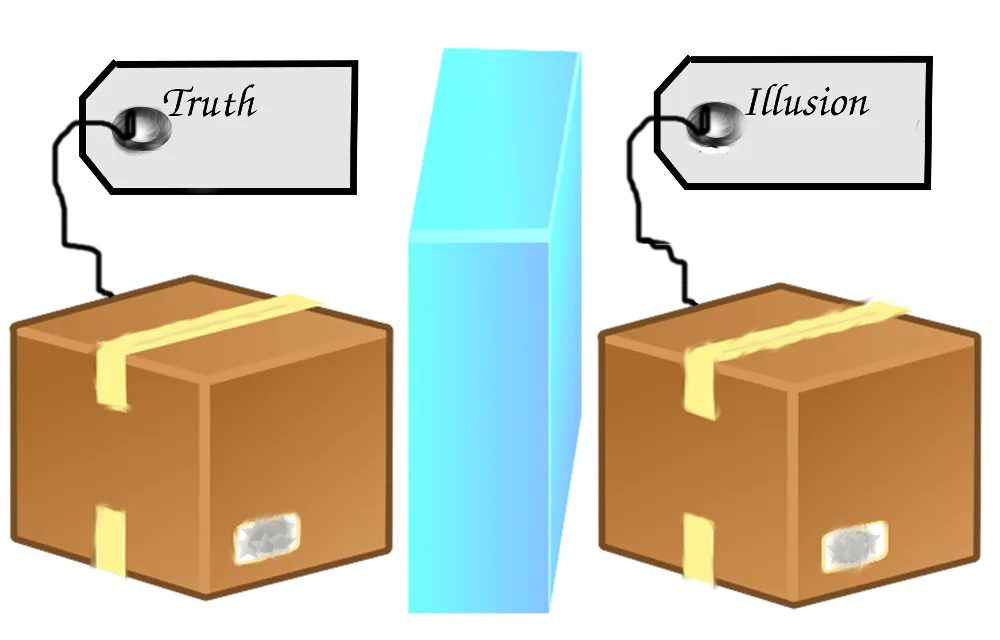
Illustration from Verbal Dancing.
“What can happen shortly after a spiritual experience or realization?
After a spiritual experience or realization, the mind tries to box it in. The mind identifies a hierarchy, and the ego identifies with it. It’s like you’re packaging your realization with a shiny wrapper called non-duality.”
A hierarchy of truth and illusion can create a distorted pattern based on fear.
In my past experiences of satsang groups and retreats, a non-dual hierarchy creates a surreal contrast between the light and the shadow that can often go unnoticed. It isolates and dissociates inner parts, especially the inner child.
I realized from these experiences that a non-dual hierarchy will always filter out certain parts, especially if they are more personal.
Now I believe that personal and impersonal aspects can co-exist peacefully. Holding them at the same time is a development of Multidimensional Awareness.
The best ice cream
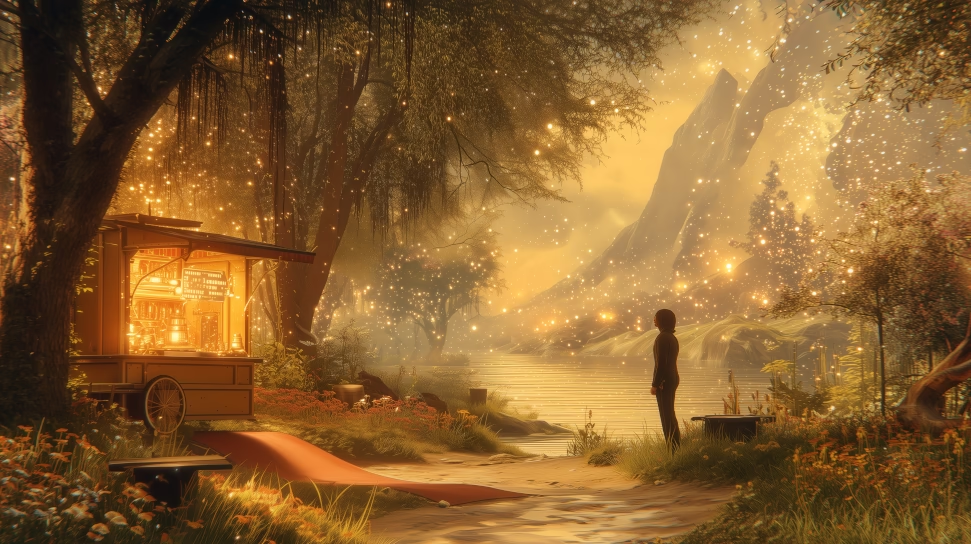
Imagine that you’re on a sunny holiday and you found the best ice-cream stall.
You have tasted many flavors of ice cream in your life, but this ice cream is the ultimate. After eating one, you immediately order another one. And you have another one before you go to sleep.
In fact, you start having one for breakfast, lunch and dinner. This ice cream is so good that you start to worship it. You just don’t respect people anymore if they don’t like it.
After a few days, you might notice that you are missing other types of food. But you immediately suppress that feeling, because you know the ice cream is so good, that you don’t want to disrespect it…
The problem is not that the ice cream was never good. Its genuine goodness becomes the reason to reject every other form of nourishment. And that is the delusion.
Creative Spirituality
Today’s non-dual insight can become tomorrow’s belief system that starts filtering your experiences. Sometimes people don’t even notice.

The basic rhythm of Verbal Dancing and creative spirituality – expanding, breathing, and expressing – can help your experience begin to flow again.
The expanding stage re-opens the framework to questioning and new perspectives.
The breathing stage allows a pause. You might notice how old conclusions loosen, and that you didn’t need them as much as you perhaps thought.
Finally, the expressing stage helps you find a new inner landing spot. You might feel an energy shift that supports meaning, agency and creativity. But now they are not fixed truths, but rather living responses to your experience.
Commonly asked questions
Is non-duality a path to true liberation or a spiritual delusion?
It could go either way, but it does depend on the type of path.
- If your path is uncompromising, radical non-duality, there is a good chance that it ends up in spiritual delusion.
- If you are willing to broaden your view beyond non-dual beliefs, the path could stay liberating beyond the first non-dual realizations.
In other words, those first non-dual realizations can be a true liberation – stepping back from negative thoughts and outdated identities. After that, the path contains a definite risk of going into a spiritual delusion, but it depends on where you go with it.
If you notice that you are using non-dual concepts to reject your experience, bypass self-improvement or reject healing, you are in the danger zone. Non-duality can easily shift from liberation into stagnation, and degrade into a dogmatic belief system.
On the other hand, opening up to new perspectives is a good antidote. New experiences might invite you to let go of non-dual beliefs (no ‘I’, there is only awareness). Presence and consciousness expansion do not depend on those beliefs – they are more like a crutch that can hold you back.
What are the dangers of getting trapped in a non-dual belief system?
In many ways, it’s similar to getting trapped in any totalizing belief system. You might stop thinking for yourself, and stop developing other interests.
This can slow down your natural flow of creative spirituality – expanding, breathing and expressing.
There are also some specifics to the non-dual belief system.
- For some people, non-duality can give a sense of self-erasure. This can especially happen if the teaching has emphasis on ego death, or tells you that you don’t exist.
- It can also lead to a sense of invalidation, like it did for me. This can feel like personal experience doesn’t carry enough weight to act on it.
- There can be a kind of self-sabotage by dismissing any thought or concept. By seeing anything constructive as an illusion, you don’t give yourself a chance to build something up.
Overall, I would say that it’s not a great idea to burn a lot of inner bridges before anything new is ready. And it doesn’t always work to replace those bridges with generic non-dual beliefs either.
What is the positive side of non-duality?
The contemplative path is a positive. It could help to skip the belief system – especially the idea that non-duality is the ultimate truth, and the rest is illusion.
Perhaps it would be better to see non-duality as a skill-set, rather than a truth. To self-inquire, observe, recognize an awareness perspective and dis-identify are all contemplative skills that someone can learn.
I don’t see that you need so many beliefs to learn that. Even the non-dual belief that ‘there is no I’, could just become a recognition of not seeing a personal self in a certain meditative state or from a certain perspective.
That way, the path could be more practical, and we could let go of some of the religious flavors.
How does non-duality decide what is ultimately real and what is less than real?
Let’s do a thought experiment.
You become a non-dualist and one day you have a realization. You start to see the world as an illusion.
For this to make sense, the thought, knowledge or realization that the world is an illusion needs to be ‘more real’ than what you see as illusion. In other words, you need some kind of hierarchy between the two.
Equally, if you see undivided awareness as the ultimate reality, you’re defining something else as less real by definition. Things like thoughts, emotions, identities and relationships, to name a few.
So, without some kind of distinction that has a hierarchy in it, the non-dual perspective doesn’t work.
The idea of undivided awareness needs to carry more weight than other day-to-day thoughts for this model to work. Some non-dualists solve this by saying that non-dual speech is like a fish that jumped out of the water. (the undivided awareness)
Overall, there is always going to be some kind of sorting into real and less real experiences. In traditional Advaita, this is expressed through the idea of Māyā. Neo-Advaita might claim that the world is just an illusion or dream.
All of this rests on certain assumptions like:
- What is eternal or constant is more real or authoritative than what comes and goes.
- We can take words that come from a realized state for gospel – never mind the underlying non-dual belief system.
- Meditative states and perspectives in which the personal self dissolves are enough reason to dismiss it as illusory.
How can a non-dual realization become ‘sacred’?
I think it can happen by putting the non-dual interpretation of an experience above any other interpretation.
Spiritual experience can be profound and liberating. But in non-dual circles, the experience is also seen as proof of the non-dual model.
(the same thing can actually happen in religion – where a spiritual experience is interpreted as some kind of revelation that proves the belief-system.)
During or after a spiritual experience, you might get told that you had a glimpse of the ultimate truth. Or perhaps this is not even said out loud – just suggested.
These kind of suggestions are very powerful, because they get linked to a certain state.
It can be tricky to see because the non-dual interpretation is often presented through negation. It can be about doing away with concepts rather than adopting them. But a non-dual model or belief-system can still live underneath that.
Therefore, you might not consciously notice that you’re picking up a belief system. But the sense that it’s sacred comes along anyway.
It can also be that some things are open to questioning while others are not. So you’re allowed to question the ‘small self’ – thoughts, emotions, patterns and beliefs. But the non-dual teaching itself, or the way the ultimate truth is defined, becomes untouchable.
How can non-duality become a gatekeeper?
By gatekeeper, I mean a mental filter. It accepts experiences as valid only if they fit within the non-dual framework.
For example, wanting to improve yourself could be interpreted as identification with thought.
Another point often comes up when the non-duality teaching is criticized. Even if the teaching is experienced as depersonalizing, or self-negating, the critique might not pass the gatekeeper. The teacher might simply repeat that in ‘reality’ there is no person to have these experiences.
How can non-duality become an identity?
This one is easier to see from the outside than from within.
You might know someone who talks a lot of non-dual language, or doesn’t use the word ‘I’ anymore on purpose. It can almost start to sound religious.
It’s harder to notice this from within because it can feel like there is no identity. But thinking that you are someone who knows that there is no identity can also be an identity.
Read more about identity: Is Michiel a Starseed?
What does a spirituality look like that goes beyond spiritual hierarchies?
Instead of a dichotomy of truth and illusion (that’s where I see non-duality as dual), you can also look at alternatives. That way, you don’t need to place an ‘ultimate reality’ on top and personal experience lower down.
And I’m not saying all hierarchies are bad – they can be very useful for understanding things. That matters both in practical life and in making sense of your inner experience.
But seeing a hierarchy as absolute removes the breathing space around it. And that can easily become the source of a belief system.
In my experience, hierarchies contrast with the purity of our original vibration – you can read more about that oneness in the Lemurian Starchild Oracle.