
A reflection on identity, inner experience, and Starseed orientation.
You might wonder what Starseed identity means for me, personally. Is it:
- a literal identity
- an intuitive language
- a way to describe inner experience.
And I would say all three – it depends on when you ask me.
If you’re new to the word Starseed, you might enjoy exploring what the Starseed lens means here.
On this page, we’ll reflect on identity, inner experience, and everything in between.
To me, the in between space is the most interesting.

How people relate to Starseed orientation
Some people already think I’m sharing a belief system, even if it’s not about Starseed identity. For them, the word Starseed can add to the expectation of a belief system.
Others might recognize that I’m sharing ideas taken lightly for inspiration. They might even recognize something familiar. Perhaps they had multidimensional experiences they never spoke about. My intuitive language might resonate with those experiences.
Others might search for identity. Perhaps they’ve explored their sensitivity as HSPs or empaths, and still feel like there’s more.
My resistance to defining myself as a Starseed
In my twenties, I started to follow non-dual teachings. I became deeply involved with non-dual teachings and groups
Some non-dual teachers I met described these kind of teachings as fingers pointing to the moon. For others, non-duality was the one truth.
Nonetheless, the meditative groups brought me deep relaxation. Exploring inner awareness calmed my nervous system.
The non-dual teachings also closed many internal loops. I didn’t need to think anymore about questions that I had carried for a long time.
I was making sense of the world using a non-dual lens.
But after a while, something shifted, and I felt a stagnation. The non-dual lens didn’t leave enough space for curiosity.
When identity becomes too rigid
It can be helpful to follow a teaching for a while. It can give a language to describe inner experience, and an orientation.
But it’s easy for a framework to become too rigid.
For me, non-duality had become an understanding for everything. But now it was starting to feel limiting.
How identity can create hierarchy
I feel that the main distortion within non-dual teachings is about hierarchy. Some are seen as self-realized or enlightened, and others are not.
A teaching claiming that there is an ultimate truth is a reliable sign of such a hierarchy. It creates a hierarchical split with what is seen as less than truth. Sometimes that is also called illusion in these teachings.
Originally, a simple way to understand my whole life had been attractive to me. But now, something that once gave me clarity and nervous system relaxation started to feel limiting.

When identity becomes helpful again
For me, things shifted when I began to embrace the basic rhythm of Creative Spirituality – expanding, breathing and expressing.
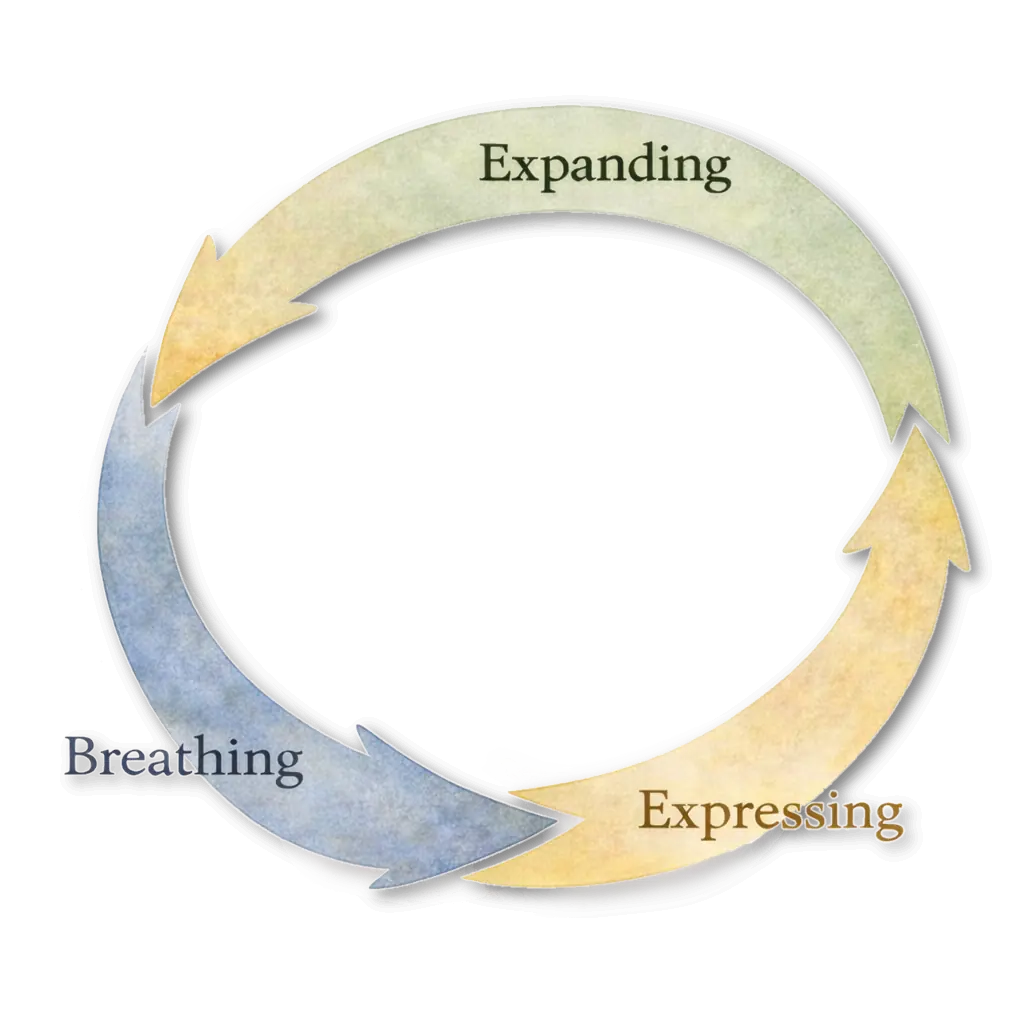

Expanding — questioning identity
Expanding is the movement of curiosity.
It means opening up to questions.
Through questions, we can explore ideas without being defined by them.
When I began questioning some of my non-dual assumptions, something softened.
I came back to a space of curiousity.
I opened up to new perspectives again.
Questioning beliefs created space.

Breathing — allowing experience to unfold
The second movement is Breathing.
The breathing stage allows us to slow down.
We can have a pause, and notice what is already here.
Breathing can be a doorway to the here and now. This was something I experienced in the non-dual groups too.
But something was different now.
I didn’t feel a need to explain everything through a system anymore.
Instead, I allowed for new perspectives.

Expressing from a Starseed orientation
Through creative spirituality, I connected with a Starseed orientation.
I might even say: “I’m a Starseed.”
At first, this didn’t feel right. I didn’t want to be limited by definitions. But something gradually shifted for me.
I realized that an identity is like an interface for communication. I didn’t need to hold onto it tightly. Instead, I could hold it lightly.
It’s intuitive language that helps to understand inner experiences.
So… is Michiel a Starseed?
After this journey, I would say:
Yes, I can embrace that now.
At the same time, I often experience it as an orientation. It describes how intuitive my inner experience is.
It doesn’t always need to be an identity. That would feel to limiting for me.
But it can be a helpful identity for describing myself to others.
Exploring identity for yourself
Perhaps you’ve also had a pause in which you asked yourself:
- What does identity really mean to me?
- How does it help to understand my experience?
- Which systems feel supportive?
- What feels too rigid?
It isn’t anything to answer immediately. But it can be interesting material to reflect on.
The basic rhythm of creative spirituality can also support such a contemplation.
It can be something to explore moment to moment, rather than something to resolve.